Buying · 8 min read
Stone Oak Real Estate for Growing Families: A Neighborhood Spotlight
San Antonio Property Pro
Atlas image · Buying
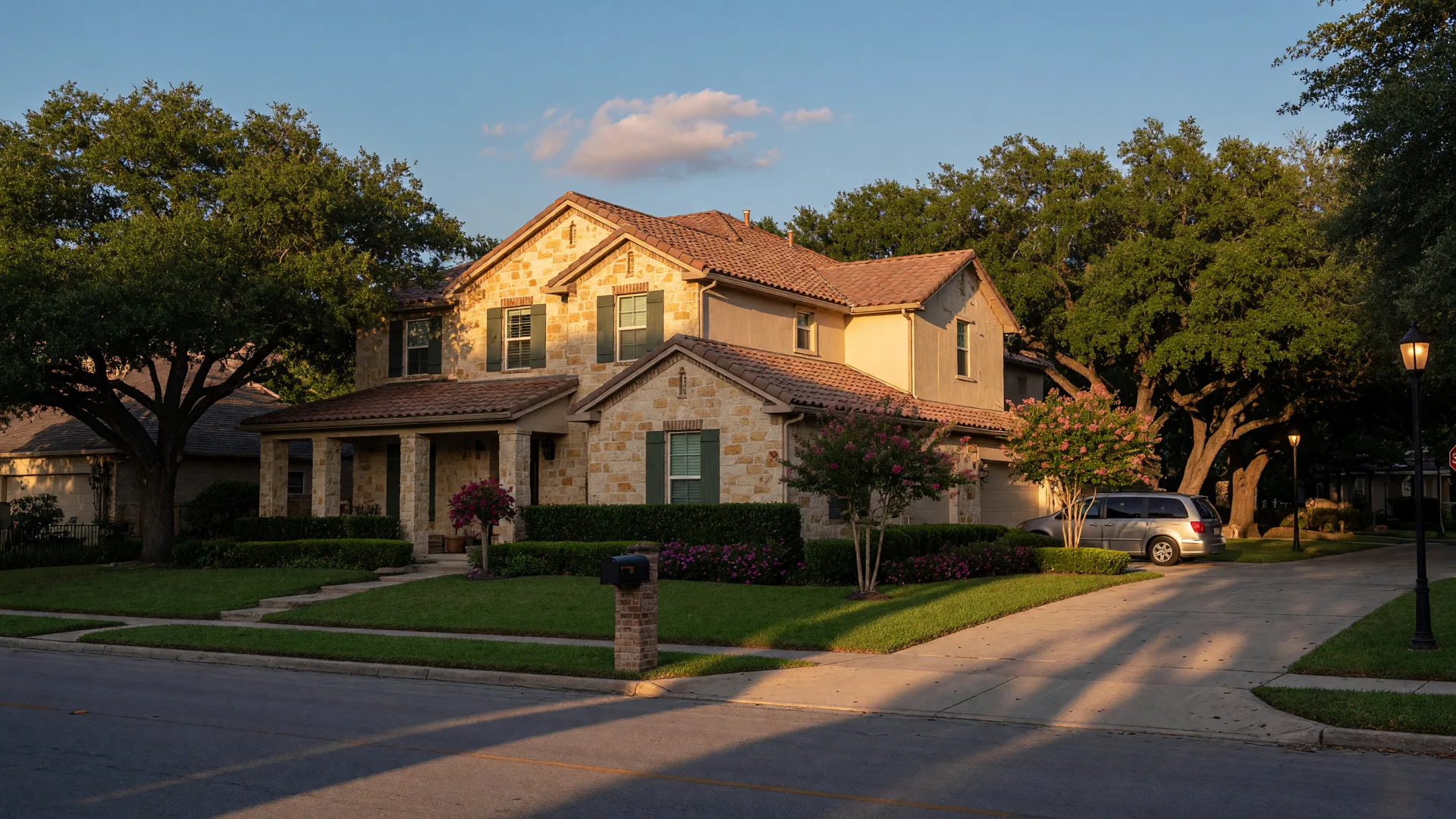
Stone Oak real estate is where a lot of San Antonio families land when they are ready for the full package: a planned community, a school district with a name, parks you can walk to, and a commute that still feels like city life. It is also a market you shop subdivision by subdivision, because four decades of growth gave Stone Oak more than forty neighborhoods with very different price points. Here is what I tell buyers who keep circling back to Stone Oak, from the market numbers to the inspection notes.
Stone Oak real estate, by the numbers
The honest headline: Stone Oak carries a clear premium over the San Antonio metro median. Citywide, the median sale price sits around $300,000, while most 2026 trackers put Stone Oak's median in the range of the mid-$400,000s to the low $500,000s, depending on the source and the week. Average home values run closer to $450,000, and price per square foot lands in the high $170s to low $180s. The range inside that number is the real story: entry-level three-bedrooms in the older subdivisions can start in the mid-$300,000s, while updated two-stories on golf-course or greenbelt lots clear $700,000 without much effort. Days on market splits the same way. A well-priced, well-maintained house on a good street can have an offer inside two weeks; a dated or optimistically priced one sits closer to two months, which is a long time at this price point.
Why families keep landing here
The schools are the engine. Stone Oak sits in North East ISD, and the feeder pattern is the reason families cross town to look here: most of the community maps to Lopez Middle School and Ronald Reagan High School, two campuses with strong reputations, while the elementary school varies by subdivision. Stone Oak Elementary, Canyon Ridge, Las Lomas, Hardy Oak, Tuscany Heights, Vineyard Ranch, and Wilderness Oak are the names you will see on home listings, and addresses on the northern edges can fall into a different pattern entirely, so the exact assignment needs to be checked against NEISD's boundary tools, not a neighbor's memory. On top of the schools, you get the community layer that makes the school run feel easy: parks, sidewalks, and greenbelts, with Stone Oak Park alone holding more than two miles of trails and most subdivisions sitting minutes from a park, a pool, or both.
Shop Stone Oak by subdivision, not by ZIP code
Stone Oak started as roughly five thousand acres of ranchland west of 281, master-planned in the early 1980s with the first phase established in 1985, and it has grown into forty-plus subdivisions. That history is why the ZIP code tells you almost nothing and the subdivision tells you everything. The Heights at Stone Oak, Stone Oak Park, Villages at Stone Oak, and the older sections along the southern edge behave like different markets: different builder vintages, different lot sizes, different HOA dues, different price floors. A home in a 1990s subdivision on a corner lot is a completely different purchase than a 2015 build on a greenbelt cul-de-sac, even when the square footage is identical. And in every one of them, read the HOA before the offer, not after: the dues, the reserves, and the restrictions, because a planned community is a promise about how the street will look in ten years, and the HOA is who keeps it.
The commute and the daily errands
Stone Oak's position, north of Loop 1604 and west of 281, is the trade-off families weigh against the schools and the lots. You can reach downtown in about twenty-five minutes in light traffic and the airport is a straight shot, but the 281 and 1604 interchanges back up in real commute hours, so the daily drive deserves a live test run at the times you will actually drive. What eases the sting is that the day-to-day rarely requires the highway. The Village at Stone Oak and the Vineyard anchor the shopping and dining, the Alamo Drafthouse is right there for movie nights, and the hospitals are the kind you want nearby with kids: Methodist Hospital Stone Oak and North Central Baptist Hospital both sit inside the community. For most families the week happens in Stone Oak, and the highway is just for work.
What an inspector checks in a Stone Oak house
Here is where my inspector license earns its keep. Most of the housing stock dates from the mid-1990s through today, which means the earliest houses are now thirty years old and their systems are on the clock. Roofs and air conditioners from that era are near or past the end of their service life, and on a two-story house the roof replacement is a real line item. San Antonio's expansive clay shows up here exactly as it does across the city, so check the foundation for settlement, the doors and windows for sticking, and the drainage around the slab for water pooling after rain. And ask about the builder grade versus what later owners upgraded: a 1998 house with updated kitchen, baths, roof, and mechanicals competes like a much newer home, while a 1998 house still wearing its original finishes sells on price, and it should.
The investor read on Stone Oak
For investors, Stone Oak is the steady long-game play rather than the month-one cash flow play. Entry prices run high enough that the yield math needs today's rates in the spreadsheet, and HOA rules plus association approval processes can narrow your rental options compared to neighborhoods without an association. What Stone Oak offers instead is the thing hardest to replace: durable renter demand from families who want the school pattern and the safety, appreciation that has compounded for decades, and an exit market with real depth when the time comes to sell. If the strategy is buy and hold with schools, parks, and jobs on your side, Stone Oak behaves. If you are chasing double-digit cash-on-cash returns, those numbers belong in a different part of town, and I will tell you that too.
The bottom line
Stone Oak real estate rewards families who shop it seriously: know the school pattern for your exact address, compare subdivisions instead of trusting the ZIP, test the commute at rush hour, budget for the age of the roof and the AC, and read the HOA before the offer. Do that, and Stone Oak is one of the most dependable family addresses in San Antonio, backed by schools, parks, and four decades of demand. Skip the homework, and a planned community can surprise you with its rules and its repair bills. Both are avoidable.
About the author: Chris Schmeis is a San Antonio real estate agent and investor with eXp Realty, a Certified Professional Real Estate Inspector in Texas, and an owner of multiple investment properties and land holdings. He writes this blog to give clients the plain-talk version of the numbers that matter.
Looking for Stone Oak real estate for your family? Text or call me, Chris at eXp Realty, and I will pull the current listings in the subdivisions that match your school pattern and budget, or point you to the live MLS search on this site so you can browse San Antonio homes yourself. Either way, you get the honest version first.
Let's run the numbersWritten by San Antonio Property Pro
Local San Antonio real estate guidance for buyers, sellers, and investors. The details above are general information, and your specific street always deserves a specific look.
Keep reading
All insightsBuying · 8 min
Alamo Heights Homes for Sale, Street by Street
Alamo Heights homes for sale sit on oak-canopied streets with a school district that sells itself. Here is the street-by-street guide to prices, blocks, and what buyers actually pay.
Read
Homeowners · 7 min
Build a Casita (ADU) in San Antonio: What Homeowners Should Know
Since 2023 San Antonio has let homeowners add a casita to almost any single-family lot by right. Here is how the size rules, owner-occupancy rule, and permitting actually work, plus the construction details that matter on our clay soil.
Read