Buying · 8 min read
King William Historic Homes in San Antonio: A Neighborhood Spotlight
San Antonio Property Pro
Atlas image · Buying
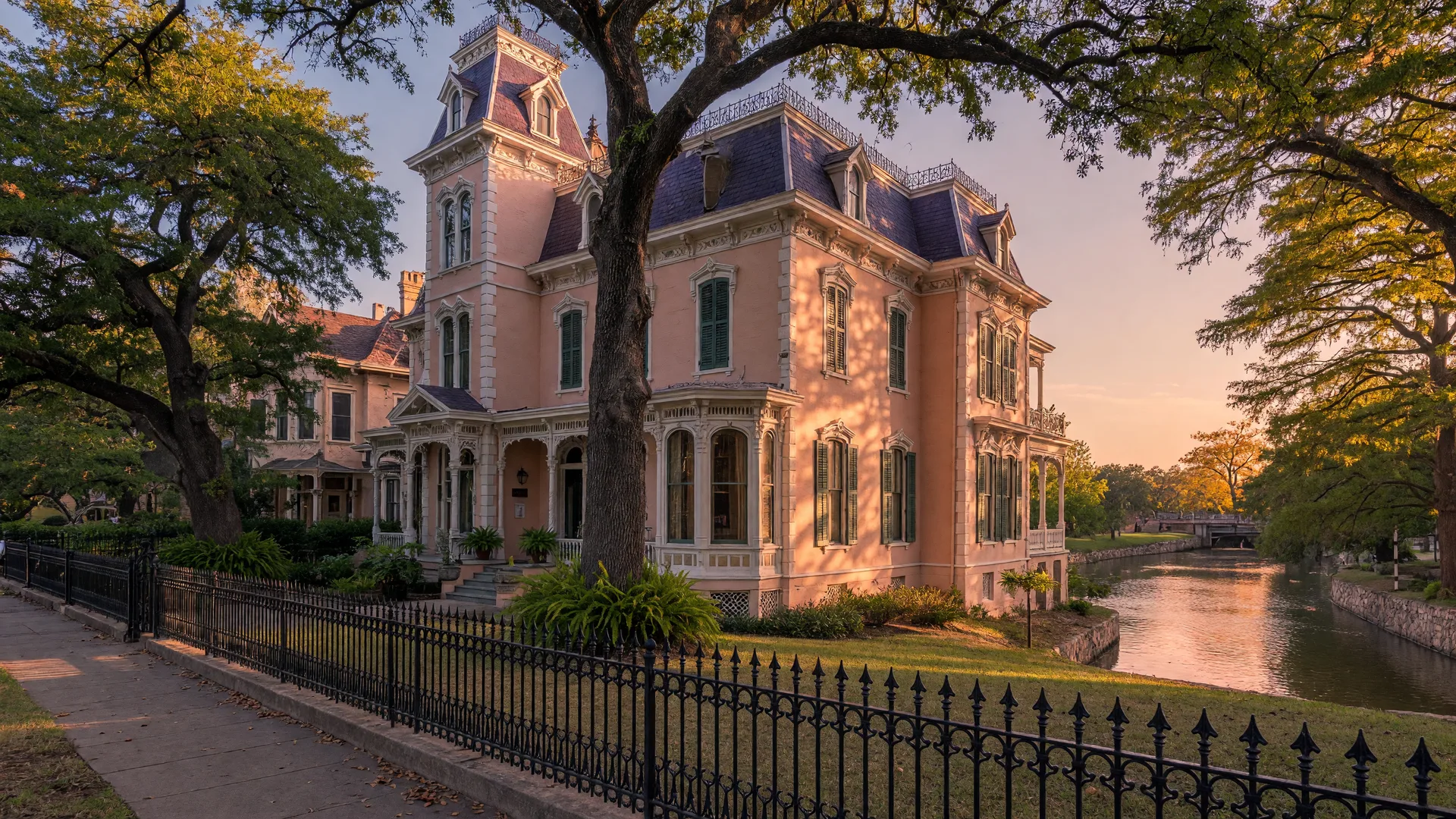
King William historic homes in San Antonio are the most romantic real estate in the city, and the least forgiving. The district is a 25-block pocket just south of downtown, built mostly by German immigrants in the second half of the 1800s, named for a Prussian king, and lined with restored Italianate and Victorian mansions the rest of the metro has no equivalent for. It is also the hardest neighborhood in town to buy carelessly: most houses are more than a century old, the river decides more than the curb appeal does, and a historic district review has a say in what you can change. Here is the honest spotlight I give buyers serious about the district, from the history to the houses to the inspection notes.
King William historic homes San Antonio, by the numbers
The first thing to understand is that King William has no normal price range, because the inventory is tiny and the spread is enormous. One 2026 neighborhood guide put the average home value around $660,000 with a price per square foot near $354, while tracker medians for recent listings landed in the upper $700,000s. The reality on the ground: a rare townhouse or a tired fixer-upper cottage can come in around the $300,000s, restored houses and condos at street level run through the $500,000s and $600,000s, and the grand mansion-style properties clear $1.8 million, with the occasional showpiece listed higher still. For context, the San Antonio metro median sale price sits around $295,000, so this district trades at multiples of the citywide number. Inventory is the real story here: a handful of listings at a time, buyers who act the week the right house appears, and turnover measured in years, not months.
How King William became San Antonio's first historic district
The neighborhood's story starts with the Germans. The land was originally the lower farmland of Misión San Antonio de Valero, the mission the Alamo comes from, and in the 1850s wealthy German settlers began buying tracts and building homes along the river. Surveyor Ernst Altgelt put the first house on King William Street and gave the street its name in honor of King Wilhelm I of Prussia, and the locals, with affection, called the bend in the river Sauerkraut Bend. By the 1870s and 1880s the district was the most fashionable address in Texas: flour-mill founders, lumber barons, and bankers building Greek Revival, Italianate, and Victorian houses that still stand today. In 1972 King William became the first residential historic district in Texas, listed on the National Register of Historic Places, and today roughly 79 significant structures survive across about 22 blocks. To walk it is to walk the 1880s, and that is exactly the point.
The landmark houses that anchor the district
Part of what makes King William historic homes in San Antonio special is that several landmarks are open to the public, so you can study the neighborhood before you ever write an offer. The Anton Wulff House at 107 King William, built in Italianate limestone in 1869 and 1870, is a museum that shows how the founders lived. The Edward Steves Homestead at 509 King William, designed in 1876 by architect Alfred Giles for the lumber baron, is one of the most photographed houses in the city. The Guenther House on Guenther Street was the home of Carl Hilmar Guenther, founder of Pioneer Flour Mills, and now holds a restaurant and museum over the river. Villa Finale, the last house saved by the National Trust for Historic Preservation, rounds out the set, and they all sit within a walkable loop. The streets themselves are the show, and the landmarks are how you read it.
Walking the district: the streets, the river, and Southtown
The district runs south from downtown, bounded roughly by the San Antonio River, Cesar Chavez Boulevard, South St. Mary's Street, and South Alamo Street, with the most beautiful blocks between Alamo Street and the water. King William Street is the spine, two lanes of restored Victorian mansions and cottages under big oaks, and the side streets off it, Washington, Madison, Adams, and the quiet bends close to the river, carry the cottage-scale houses that make the district reachable at more approachable prices. The river is the neighborhood's living room: the Museum Reach, the arts-focused northern arm of the River Walk, runs right along the district's edge, with public art and the walkway up to the San Antonio Museum of Art and the Pearl, and to the south the Mission Reach trail heads out toward the missions. Southtown, the arts district next door, puts the Blue Star Arts Complex, galleries, and coffee within a short stroll. You can live at the heart of the city's Historic and Cultural Arts corridor and not start a car all weekend.
Schools and the calendar: Bonham, Brackenridge, and the King William Fair
The district sits inside the San Antonio Independent School District, with neighborhood schools that include James Bonham Academy for the elementary and middle grades and Brackenridge High School, and the walk to campus is a real part of the charm for the families who live here. The neighborhood's signature moment on the calendar is the King William Fair, held each spring as part of Fiesta: a juried arts-and-crafts market, a historic parade, food and live music spread across the district, and the event that raises money for the King William Association. It started in 1967 as a block party and has grown into Fiesta's biggest residential party, drawing tens of thousands of visitors in a single weekend. If you are shopping here, walk the fair once before you commit: you will meet the neighbors, see the houses with their doors open, and learn more about the district in one afternoon than in a month of listings.
What the historic district rules actually allow
This is the section that filters buyers, and it should. King William's historic status protects the neighborhood, and with protection comes process: exterior work that changes the look of a house, from paint colors and siding to windows, porches, and major additions, generally needs a Certificate of Appropriateness. For the individually designated landmark structures, the review is stricter still, through the city's Office of Historic Preservation and the Historic and Design Review Commission, which holds public hearings. That is not a reason to walk away, it is a reason to buy with your eyes open. The buyers who thrive here decide early whether they want a museum-grade restoration, a practical renovation that respects the exterior, or simply a house they will maintain as-is, and they price their plans before they price the offer. The rules are the reason the district still looks like the 1880s. If that sounds like a feature, this is your neighborhood. If it sounds like a headache, the established streets of Alamo Heights, Terrell Hills, or Monte Vista may fit your life better, and I will tell you that honestly before we go looking.
Inspection notes on an 1870s house by the river
Now the part where my inspector training earns its keep. Nearly all of King William's houses are more than a century old, and on riverfront soil the biggest question is water. The river has flooded in living memory, in 1921, 1998, and 2002, so I always ask about the flood history of the exact lot, check the grade and drainage, and look for moisture and old foundation movement before the romance of the listing wins. Then come the systems of a 140-year-old house: original or patched electrical, galvanized or lead plumbing, plaster walls hiding the real condition of the structure, and heating and cooling added room by room over decades. Add lead paint and, on the landmarks, preservation covenants, and the honest line is this: in King William you are buying a 140-year project along with its foundation. The flip side is that the district rewards diligence. Well-documented renovations, newer systems, and stabilized foundations carry real value here, and a house that has been cared for properly sells at a premium. That is exactly the kind of read an agent who is also a certified inspector can give you.
The investor read on King William
For investors, King William is a different animal from the rental corridors on the north side, and I will be honest about that upfront. The entry price is high, the historic review limits what you can change, and the city's short-term rental rules are tight, so the classic cash-flow math rarely pencils on the big mansions. What the district offers instead is scarcity and stability on an extreme scale: a handful of listings, a deep pool of well-qualified, design-literate buyers, and appreciation driven by the simple fact that nobody is building new 1880s mansions. The more realistic plays are the smaller cottages and townhouses at more approachable price tags, renovated units that rent well to professionals who want the address, and patient long-term holds. If cash flow is the goal, I will point you toward the corridors by Schertz and Cibolo or the north-side family neighborhoods instead, and if a turnkey Hill Country rental is the dream, we talk New Braunfels, Boerne, Bulverde, Fair Oaks Ranch, or Helotes. King William is a store of value with a story, not a yield machine.
Beyond the district, when the romance needs room
Most buyers I bring to King William fall in love with the neighborhood and then have an honest conversation about space. The mansions are grand and the cottages are small, parking is scarce, and the schools, while solid, are not the draw that the north-side districts are. If heritage matters more than square footage, the other historic pockets, Monte Vista, Lavaca, and Tobin Hill near the Pearl, give you similar bones with different trade-offs. If you want the city's classic established streets with bigger lots, Alamo Heights and Terrell Hills are the natural comparison. And if the lifestyle you are really after is the Texas Hill Country, the river towns of Boerne and New Braunfels, the gated communities of Fair Oaks Ranch, the ranchero feel of Helotes and Bulverde, and the family-friendly corridors of Schertz and Cibolo all deliver it with acres, schools, or new construction that the district cannot. The strongest buyers in this market decide which of those worlds they actually want to live in before they start touring, and that is a conversation worth having first.
The bottom line
King William historic homes in San Antonio reward buyers who respect the district on its own terms. Start with the history, because that is the point of the place. Shop the numbers street by street, because the spread is enormous and the inventory is tiny. Walk the river and the fair with a buyer's eyes, and get the rules in writing before you fall for a house. Inspect like your future depends on it, because a 140-year-old house by the river keeps its truth in the foundation, the wiring, and the flood history. When the romance and the research both hold up, there is no address in San Antonio quite like it, and the city's first historic district stays as rare as it has always been.
About the author: Chris Schmeis is a San Antonio real estate agent and investor with eXp Realty, a Certified Professional Real Estate Inspector in Texas, and an owner of multiple investment properties and land holdings. He writes this blog to give clients the plain-talk version of the numbers that matter.
Thinking about King William historic homes in San Antonio? Text or call me, Chris at eXp Realty, and I will pull the current listings in the district, walk the comps house by house, and visit any property with an inspector's eye before you write an offer. If the district is not the right fit, I will help you find the neighborhood across the metro and the Hill Country that is.
Let's run the numbersWritten by San Antonio Property Pro
Local San Antonio real estate guidance for buyers, sellers, and investors. The details above are general information, and your specific street always deserves a specific look.
Keep reading
All insightsBuying · 8 min
Southtown San Antonio: The Live/Work Appeal for Buyers
Southtown San Antonio real estate is the city's most walkable live/work corner: lofts and restored cottages near the Blue Star Arts Complex, the Mission Reach river trail, and a Walk Score near 90. Here is what buyers should know.
Read
Buying · 9 min
What's My Closing Timeline? A San Antonio Buyer's Week-by-Week Guide
How long does closing actually take? The honest home closing timeline in Texas, week by week: option period, appraisal, title work, and the day you get the keys in San Antonio.
Read